
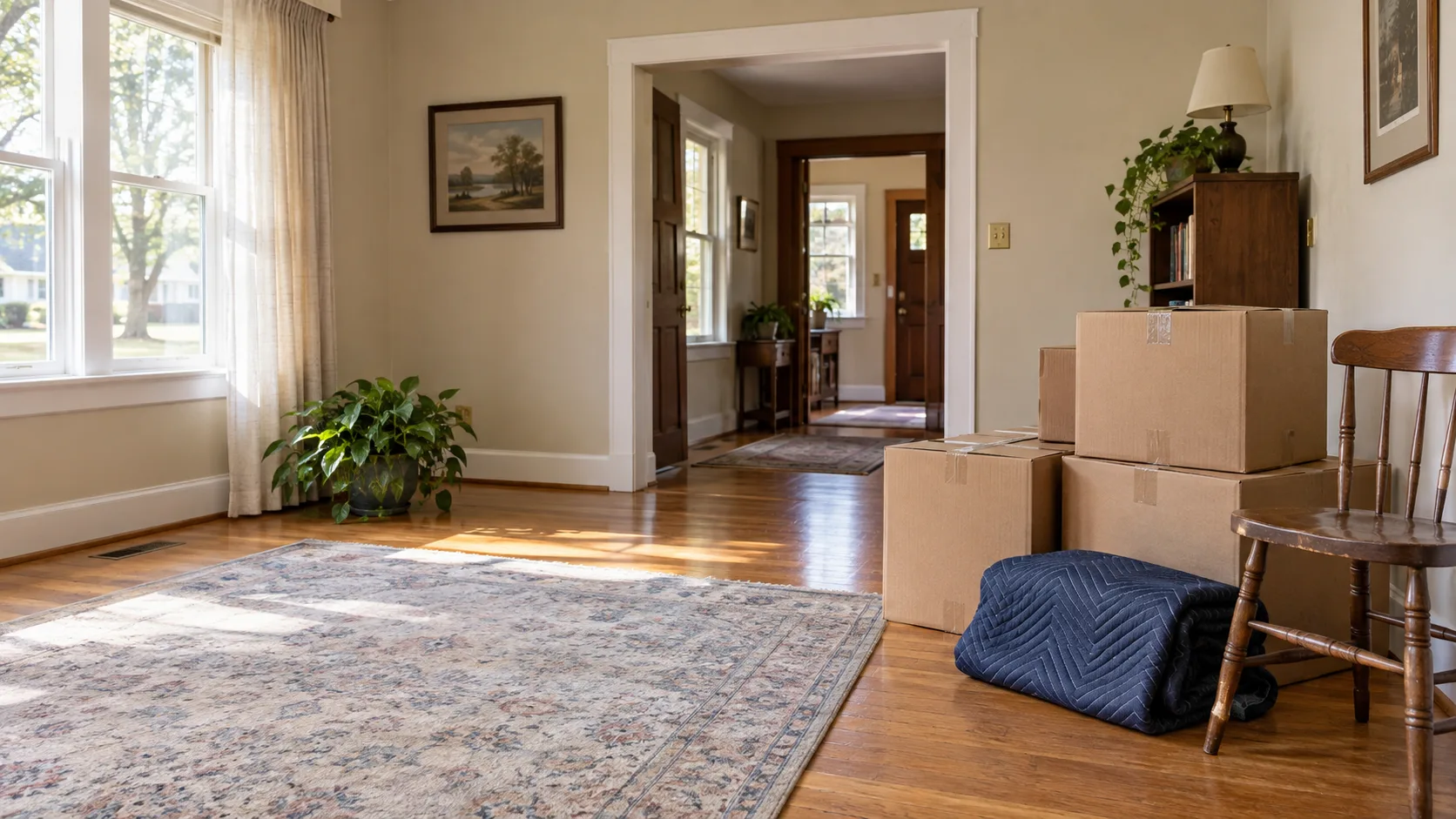
Measure the narrowest part of the route, not the largest room. Record doorway width and height, stair width, landing depth, sharp turns, low ceilings or pipes, distance to the loading area, and available parking. Then photograph the route from the item to the exit.
These measurements do not replace an on-site assessment. They help the estimator spot where a large object may need disassembly, a different carrying plan, or more labor.
Access worksheet
| Measure or note | Where to check | Record |
|---|---|---|
| Narrowest doorway width | Door open, from the inside edge of the opening to the opposite stop | _____ inches |
| Doorway height | Floor or threshold to the lowest fixed point | _____ inches |
| Stair clear width | Between the handrail and opposite wall or obstruction | _____ inches |
| Landing depth | Available floor space at the tightest turn | _____ inches |
| Lowest overhead point | Pipes, ductwork, beams, door closers, garage tracks | _____ inches |
| Carrying distance | From the item area to the expected vehicle position | _____ feet or paces |
| Steps and turns | Total steps plus any 90- or 180-degree turn | _____ steps / _____ turns |
| Parking limits | Driveway, street restrictions, gate, alley, or loading zone | Notes: __________ |
Measure the item only when it is safe to reach
For a couch, cabinet, appliance, or exercise machine, record width, depth, and height. Include fixed handles, arms, feet, and control panels. Do not tip or pull a heavy object away from the wall just to reach the back. Tell the crew when a measurement is approximate.
Look for removable parts that the manufacturer intended to detach, such as shelves or a table leaf, but do not begin disassembly if the item is under tension, wired, connected to gas or water, or too heavy to stabilize.
Photograph the route in sequence
- Take one wide photo of the item in its current position.
- Photograph the first doorway or stair from the item side.
- Show each landing, turn, and overhead obstruction.
- Show the exterior exit, steps, gate, and expected vehicle position.
- Add a close photo only when a specific condition needs explanation.
A sequence is more useful than ten close-ups of the object. Remove personal papers, family photos, account information, and other private material from the frame before sending property images.
Do a hazard pass
Note loose steps, missing handrails, soft flooring, standing water, poor lighting, low electrical service, broken glass, pests, mold, or structural damage. Do not cover these conditions with boxes or rugs. Some problems need correction or specialist assessment before removal work can proceed.
Garages and basements also collect fuels, oil-based paint, solvents, pesticides, automotive fluids, batteries, and compressed cylinders. Keep containers closed and upright. Do not combine liquids or open an unknown container to identify it. Follow the local hazardous-waste route described in the household hazardous-waste guide.
Why weight is not the only lifting question
The NIOSH lifting model considers several variables, including object weight, the height and reach of the hands, travel distance, asymmetry, frequency, duration, and grip quality. Tight turns and low clearances can force awkward positions even when an object is not exceptionally heavy. Review the NIOSH Revised Lifting Equation overview for the underlying factors.
OSHA also recommends mechanical means and handling equipment for heavy or bulky materials when possible. A professional assessment can decide whether a hand truck, additional crew, disassembly, or a different route is appropriate. Do not use this worksheet as permission to attempt a lift beyond your ability.
Send a short access summary
A useful first message can be brief: “Basement sofa, 34-inch stair width, one 90-degree landing, 74-inch low pipe, 45-foot carry to driveway.” Add photos and mention other heavy or dense items.
Call or text 216-217-7667 to discuss the route. The basement and garage cleanout page lists the other details that help shape the estimate.
Sources checked
- NIOSH Revised Lifting Equation — general occupational lifting-risk variables; retrieved September 17, 2026.
- OSHA Materials Handling: Heavy Lifting — general occupational materials-handling guidance; retrieved September 17, 2026.
- Cuyahoga County Household Hazardous Waste — Cuyahoga County household hazardous-waste guidance; retrieved September 17, 2026.